
BACKSEAT DRIVERS
A late-night limo ride leaves Lennon and Dylan at loose ends. LUCIEN ASHCROFT-HEMMINGS hears it all.
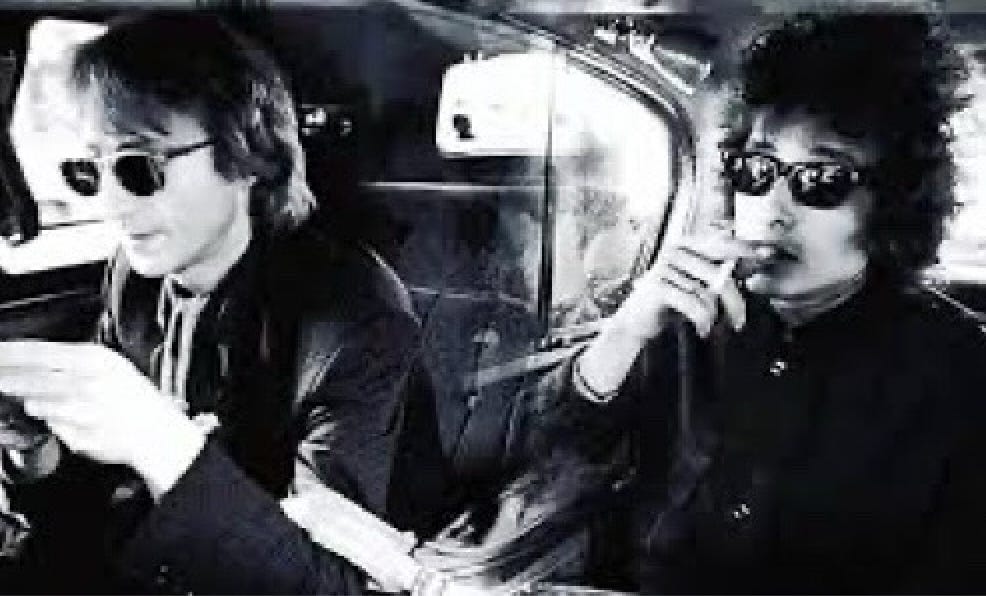
Somewhere between the Savoy and the vomiting, as I hugged the curb of the rain-slick embankments of the Thames, two of the most influential artists in the English-speaking world sat in the back of a rock-star limousine last night, improvising themselves into oblivion whilst a documentary camera belonging to D.A. Pennebaker whirred its way into history — the two artists being Bob Dylan and John Lennon, partners in rhyme.
And there I was behind the wheel: Lucien Ashcroft-Hemmings, reporting for undercover duty as a swing-shift limo driver to the stars. The stated purpose of my hastily obtained chauffeur’s license was to determine the difference between Dylan and Lennon, once and for all, assuming there was any. I did my due diligence by listening and learning via the rear-view mirror of Lennon’s Rolls-Royce Phantom V limo; in the retelling, I will lob the occasional bon mot in your direction. Get ready for ribaldry, mes amis.
Officially, for tonight I am “Tom.” I may be easy on the eyes, but I still toil as a poorly paid freelance social anthropologist, in my current capacity as a night-shift chauffeur under an assumed name. At this late hour, I am currently shuttling two deeply exhausted demigods through the darkened London side streets whilst attempting not to steer the Rolls directly into the Thames. I did what I could, considering my lack of proper driving credentials and a tendency toward ungodly speeds.
The details surrounding this off-the-record-until-now Dylan–Lennon encounter will likely harden, in a matter of hours, into cold historical fact: Lennon meets Dylan for a late-night chinwag, cameras rolling to record every utterance. Wit wafts over the local landscape as these two geniuses collude and commune amid concrete, rubber, and glass. What is taking place here — at least as I observe the proceedings from a discreet distance — resembles two college dropouts trying desperately to out-improvise the other whilst pretending not to notice the ill-informed lunacy lurking behind every word.
Dylan kicks off the kookiness with an observation at once so grandiose and so absurd that I will never forget its foolhardy overreach. Nor can I ignore its intimation of intellectual heft.
“There’s the mighty Thames,” Dylan announces to no one whilst peering into the rain. “That’s what held Hitler back.”
From what? You may well ask. I did. Still waiting for word. Long stretches of silence — that’s how Bob rolls, even in John’s Rolls.
Indeed, one immediately notices in those throwaways the Dylan bluster in full bloom: half-American huckster, half-Dust Bowl oracle, speaking in rolling riffs rather than staccato sentences. By this stage of the fame game, Dylan no longer converses or concludes; he free-associates ideas the way comedians concoct amusements. Words emerge like cards flung across a poker table. Tyrone Power becomes Ronald Colman becomes Robert Johnson becomes Johnny Cash becomes J. Carrol Naish. You see my point.
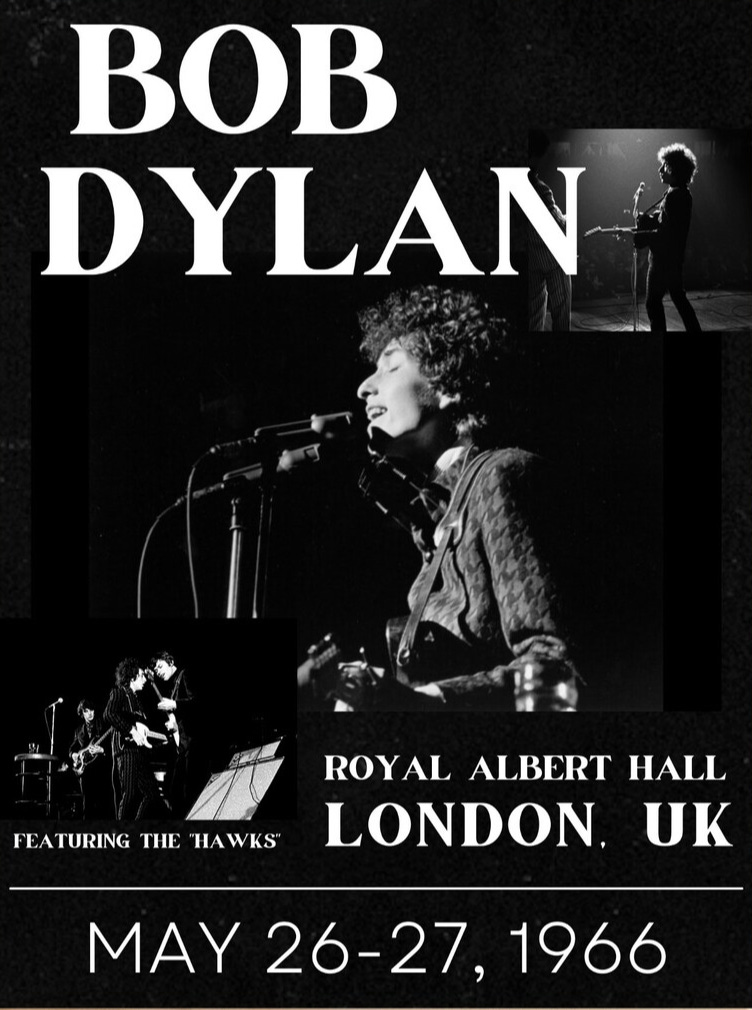
And Lennon — magnificently, instinctively, absurdly — understands Dylan’s game, even if he chooses not to play.
“Johnny Cash, or all the rest of them,” he replies, not really listening.
***
In summary, Lennon is no longer the cheeky Beatle trying to impress Dylan, as he was in 1964 when Bob introduced the boys to marijuana and, by extension, to the inner workings of their cerebrums. That phase has faded. Nowadays, Lennon meets Dylan as a fellow practitioner of the dark arts. These two men have both discovered that celebrity itself can be manipulated, just as tape loops have taken conventional composition and turned it inside out.
The result is less rock music than jazz, if I’m being truly didactic.
Dylan praises Johnny Cash’s physicality — “He moves like all good people. Like prize fighters” — and Lennon instantly transforms a banal observation into a full-on parody of fanboy enthusiasm: “Johnny! Big River, Big River!”
What actually sat behind me in this overstretched limo were two postmodern vaudevillians. Lennon had dissolved his lovable mop-top character into a succession of masks: acid wit, wounded cynic, media parody, and Northern absurdist all served as disguises that let Lennon roam free. Dylan, meanwhile, settled for media-sanctioned sainthood.
“I wish I could talk English, man,” Dylan sighs.
“Me too, Bobby,” Lennon replies instantly, sardonically, confusingly. Not every aphorism needs to arrive pre-decoded.
✦ ✦ ✦
Without segue or sense, Dylan recalls a half-imagined earlier encounter involving Northern Songs, Paul McCartney eying the exits, Mick Jagger “blow[ing] shit from his nose,” and Rob Roy bursting into the room in a kilt. Is any of it true? Maybe, maybe not, and that is precisely the point. Without any apparent awareness, Dylan and Lennon were somehow creating anti-journalism — stories that serve to destroy reportage, not celebrate it.
Lennon keeps steering the conversation toward America’s latest pop movements: The Mamas & the Papas, Barry McGuire, The Silkie. Why? Because lately the Beatles have grown acutely aware of California as the new frontier. Brian Wilson may have constructed Pet Sounds, Dylan may have electrified folk, but Los Angeles is generating a softer form of pop mysticism. Ever alert to shifting cultural trends, Lennon probes Dylan like a doctor with a thermometer, seeking heat in a world where everything is measured in coolness.
Then — and this is where the limo ride veers into an oddly moving vein — the masks begin to slip.
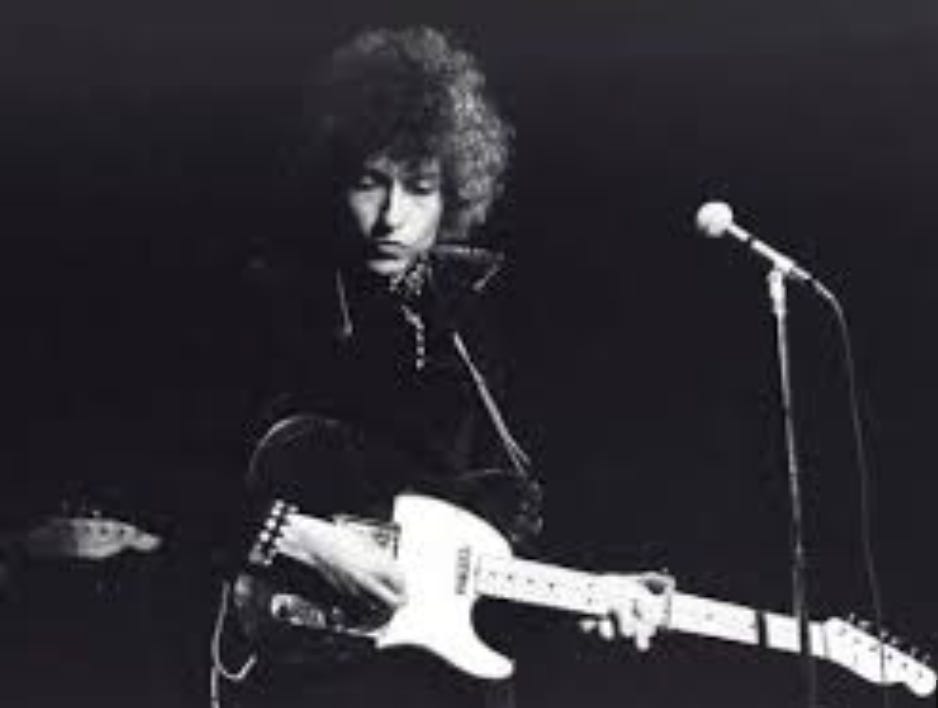
“I wanna go back home,” Dylan says quietly. “I wanna go back home, man, see a baseball game, all-night TV.”
Suddenly the carnival barker vanishes. In his place appears a 24-year-old Minnesotan exhausted from the endless demands of celebrity.
✦ ✦ ✦
These days, both men appear to be trapped inside machines they themselves have built. The Beatles can still scarcely hear themselves think over the screaming. Dylan is midway through his amphetamine-fueled world tour whilst Lennon lurches his way through the making of the Fabs’ latest masterpiece.
Perhaps each envies the other’s escape hatch. All Dylan will admit is a medical malady: “I’m very sick, man,” he avers without elaboration.
“With the tremors?” Lennon lightly inquires. That’s trademark Lennon: emotional sincerity smuggled inside jokes like contraband whisky.
“What if I vomit into the camera?” Dylan groans. “I’ve done just about everything else into that camera.”
I drop them off at the Mayfair and leave my vehicle undetected on a side street. I have a quick smoke, oddly haunted by Lennon’s low-key role throughout the ride. Popular mythology often casts Dylan as the intimidating avant-garde genius and Lennon as the eager disciple. Yet here Lennon sounds meek and modern. I suppose I’m destined to remain undecided in this regard. The answer is blowin’ in the wind. See what I did there?
-30-