
CHRIST ALMIGHTY!
John Lennon declares the Beatles "more popular than Jesus" to LUCIEN ASHCROFT-HEMMINGS. Will anyone care?
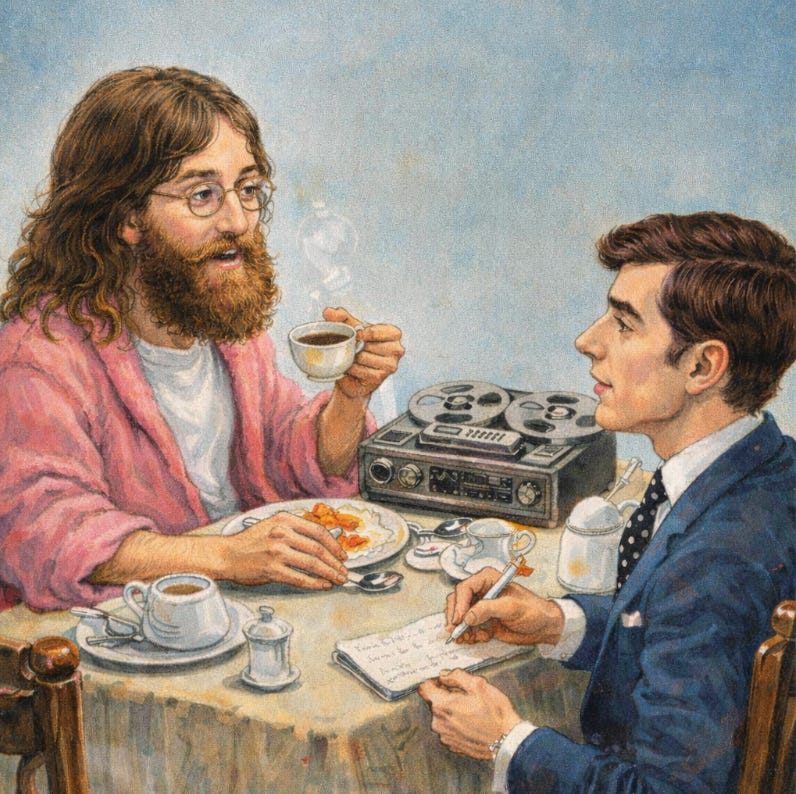
I’m reliably informed that among journalists who jaw regularly with rock stars, it is axiomatic that one respects the roped-off boundaries of behavior governing denizens of the demi-Gods known as the Beatles. What this means, I am further told, is that those of us who practice the finer arts of critical inquiry must defer to lesser lights — I refer here to “reporters” — to ask the questions that shape our necessarily limited understanding of the creative mind.
My deepest apologies to my Beatles Magazine colleagues who sought this assignment — that especially includes business reporter Bitsy Carlisle, who openly covets the role of running our John Lennon bureau — but I have prevailed upon our editrix-in-chief, C.J. Baxter, to grant me the privilege of presiding over the magazine’s fourth and final entry in our A Beatle Observed series. Hence my presence in Weybridge, Surrey, for a chinwag with Lennon, during which I would seek newsworthy responses from a man who likes to provoke listeners down to the remaining drops of their precious bodily fluids.
In that spirit, I anticipated that any inquiry touching even obliquely on the deeply-personal particulars of organized religion would potentially ignite a small conflagration. Such subtleties of signal recognition, my friends, are typically the byproduct of my own quotidian habits —reading Aeschylus whilst listening to Sibelius’s Second Symphony (preferably the Concertgebouw recording), and casually registering Lennon’s louche levity as a precursor to what would shortly transpire. I accept full responsibility for any outcome of this high-wire encounter between artist and critic.
Consider me unchastened by the chasm that will surely open upon publication of our incendiary interchange. And do, while you are considering matters, also recognize me for any journalistic kudos that might accrue from my maiden voyage into the vulgar world of reportage. Prizes, checks and provocative photos may be sent to me in care of The Beatles Magazine. I shall endeavor to be gracious, though graciousness is not — even remotely — my wont.

Perhaps, in retrospect, I might have gained a slight edge by giving David Frost or Oriana Fallaci a quick gander at my opening query — which, to foreshadow the obvious, proved to be a provocative conversational kickoff. Such interlocutors may not have wished to bear responsibility for what was about to happen, but they nonetheless served to inspire my move into the art of the interview. I feel no regret for adding a half-inch of bourbon into my double espresso as Lennon and I took our seats amid the chaos of his dining-room table. While the smell of freshly charred bacon singed my soul with hunger, I could find no proof of its existence underneath several days’ unread copies of The Times.
✦ ✦ ✦
“You’re far too handsome to be an ink-stained wretch,” Lennon allowed as his opening gambit.
“So I’ve been told,” I replied gamely, revealing perhaps too much to Lennon of my own flirtatious dealings with the fairer sex. I suppose, in the presence of an artist whose iconic good looks leave most birds breathless, I sensed an opening to explore common ground.
“Well, fire away with your queries,” Lennon said impatiently. “I haven’t got all day. Although if you must know, I actually do.”
Lennon then unleashed the full-scale grin that melted millions at the peak of Beatlemania — thin lips parting to reveal a toothy smile so smashingly effective that I wondered why Picasso had denied Les Demoiselles d’Avignon a similarly denture-driven revision.
But never mind that. I had secured C.J.’s explicit approval to dig deep into the core belief system driving Lennon’s artistry.
“All right then, John, here we go,” I said, wiping my glasses with the tail of my Turnbull & Asser shirt as I perused the pile of books astride Lennon’s dirty dishes. “I see you’re reading Bertrand Russell. I’m with you there, mate. A History of Western Philosophy is right good fun. But the one that gets my blood up is his Why I Am Not a Christian. Will Russell result in a mass exodus from organised religion — fuelled by the Beatles’ ascendance? I’m kidding, of course.”
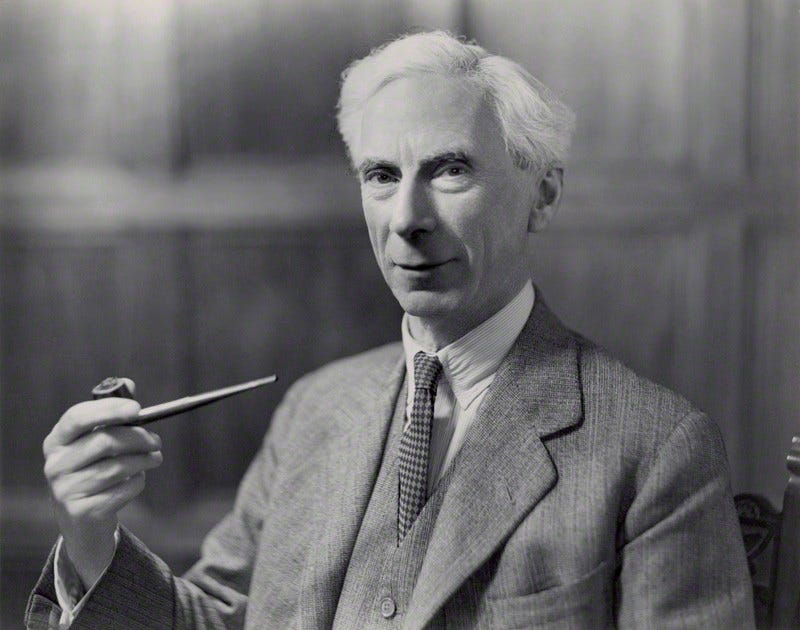
To say that my innocent inquiry prompted Lennon to lean forward is a considerable understatement. He fairly pounced, his pointed reply reverberating against the bucolic Surrey hilltops — and, depending on who hears it, quite possibly landing directly in the pages of history.
✦ ✦ ✦
“Christianity will go,” Lennon answered matter-of-factly, as though repeating the latest rain forecast. “It will vanish and shrink. I needn’t argue about that. I’m right and I will be proved right. We’re more popular than Jesus. I don’t know which will go first — rock ‘n’ roll or Christianity. Jesus was all right, but his disciples were thick and ordinary. It’s them twisting it that ruins it for me.”
How now, brown cow.
Readers, I recall little of what followed. Never in the annals of intellectual discourse have I heard anyone declare himself more beloved than Our Lord Jesus Christ, and I immediately checked my tape recorder to ensure Lennon’s casual encomium had been properly preserved. Technology, I trusted, would protect me from the sudden erasure of Lennon’s declaration from my stunned brain.
Perhaps cognizant of his overreach, Lennon demanded that I forthwith desist in any further efforts at serious inquiry and consider our conversation complete. He reached across the table and turned off my recording device, whilst flashing a devious, knowing grin. I spent the remaining one hour and fifty eight minutes of our visit in random chit-chat about inconsequential matters, of interest only to mop-top-mad subscribers and those concerned with Lennon’s latest opinions of forthcomimg inclement weather conditions.
While we chatted, my thoughts returned obsessively to the unintended — yet wholly inflammatory — impact of Lennon’s declaration. More popular than Jesus. Did this reflect an outsized perception of the Beatles’ place in the world? Would millions of fans find their way to these words? Would they acknowledge, accept and accede to Lennon’s self-conception as a faith unto himself? Or had I misheard this hellion’s words in my haste for a headline?
“You’re perhaps reading too much into an idle remark,” C.J. observed, peering in my direction over her half-glasses as I played her the tape over two whiskey sours the following afternoon. “Besides, we’re just The Beatles Magazine. Leave the heavy lifting to the The Saturday Evening Post.” I accepted C.J.’s sensible verdict, and in classic neophyte fashion I’ve buried the lede. For now, at least, the secret of John’s sacrilegious self-absorption would be preserved solely in the pages of The Beatles Magazine. One wonders if anyone will even care.
-30-